Question 01
What does financial consulting look like for an HVAC company?
For home services contractors, financial consulting starts at the job level. The core question is always the same: what does each job actually cost once you account for technician labor, drive time, materials, callbacks, and overhead allocation? Most HVAC companies have a general sense of their margins — but very few have true visibility into profitability by job type, technician, or geography.
That's the first bottleneck we address. We build the data infrastructure to answer those questions cleanly — often using the
field service management software the business already has, like ServiceTitan or Housecall Pro, combined with their accounting system. Once the data picture is clear, we move on to the strategic questions: which services should you grow, where are you underpricing, and which parts of the operation are quietly eroding margin?
On pricing specifically: I advise home services owners not to price relative to what the competitor down the road is charging, but relative to the value they're delivering to the customer. A technician who shows up on time, diagnoses correctly the first time, and completes clean work can command a premium — and should.
Key Takeaway
Effective consulting for home services contractors starts with
job-level profitability visibility, builds from there to strategic pricing and operational decisions, and uses your existing software as the data foundation.
↑ Back to Questions
Question 02
How does a financial advisor actually help an HVAC business grow?
The most common scenario I encounter is an owner who is fully booked, running hard, and still not seeing the cash accumulation they expect. The business feels successful but the bank account doesn't reflect it. That gap — between revenue and realized profit — is where HVAC business growth stalls most often, and where a financial thought partner adds the most immediate value.
We begin with a financial Sprint: compiling all historical data into clean, GAAP-aligned statements — P&L, cash flow, balance sheet — and identifying the two or three
KPIs that most directly drive profitability for that specific business. For a residential HVAC company, that might be revenue per technician per day, average ticket value, and maintenance agreement attach rate. For a commercial plumbing contractor, it might be job margin by contract type and change order capture rate.
From there, we work with the owner to define growth objectives and build a simple, ongoing cadence for tracking those metrics — so that decisions about hiring, equipment, territory expansion, or service mix are grounded in data, not instinct alone.
Key Takeaway
A financial advisor helps bridge the gap between a busy, revenue-generating home services business and one that is actually building wealth — by identifying the specific KPIs that drive your profitability and tracking them consistently.
↑ Back to Questions
Question 03
How do I find the right growth consultant for my HVAC business?
The home services industry has no shortage of generic business coaches and marketing consultants. What's genuinely rare is a consultant who understands the operational economics of field service businesses — dispatch efficiency, technician utilization, seasonal revenue curves, and the difference between gross margin on a maintenance call versus an install job.
The best referral path is to find contractors who have scaled successfully — companies that have grown from, say, $2M to $10M in revenue — and ask who gave them the clearest financial and strategic guidance. Often it's a board member, a PE-backed peer, or an operator from an adjacent industry who asked the right questions at the right time.
What you want to avoid is a consultant who arrives with a generic framework and applies it to your business without understanding the seasonality of HVAC demand, the labor dynamics of licensed electricians, or the cash flow mechanics of a large plumbing installation project. The right partner will want to understand your business before offering a single recommendation.
Oryx Horn was built specifically for home services contractors with $1M or more in revenue who need sophisticated financial and commercial guidance — not generic growth advice.
Key Takeaway
Look for a consultant with direct experience in field service economics, not just general business coaching. Ask contractors who have already scaled who gave them genuinely useful financial guidance.
↑ Back to Questions
Question 04
What services do business advisors provide to HVAC contractors?
For HVAC businesses, advisory work in support of HVAC business growth typically falls into three buckets.
The first is the financial baseline Sprint — a time-bounded engagement to compile historical financials, clean up the data, and produce a clear picture of past performance by service line, geography, or technician. For many contractors this is the first time they've seen their P&L broken down below the top line, and it immediately surfaces where margin is being made and where it is being lost.
The second is ongoing retainer work — typically monthly or quarterly — where we track KPIs, support hiring and investment decisions, and act as a strategic sounding board for the owner. HVAC business growth tends to stall at predictable inflection points: adding a second trade, hiring a first office manager, expanding to a new territory. Having a financial thought partner at each of those moments significantly reduces the risk of a costly misstep.
The third is project work: a focused, time-bound engagement around a specific question. Examples include analyzing which job types or customer segments are most profitable,
pricing a service call fee structure correctly, or building a financial model to evaluate whether to bring dispatch in-house or continue outsourcing.
Key Takeaway
Advisors supporting HVAC business growth offer baseline financial diagnostics, ongoing strategic support through growth inflection points, and focused project work on specific operational or pricing questions.
↑ Back to Questions
Question 05
What are the best financial planning strategies for HVAC owners?
There is no single answer — HVAC business growth strategy depends heavily on where the business is in its growth cycle and what the owner is trying to build. A residential HVAC company with $3M in revenue and aspirations to sell in five years has very different financial planning needs than a commercial HVAC contractor trying to double headcount while maintaining install quality.
That said, the most consistently valuable planning exercise for home services businesses is building a clear model of revenue per technician per day — then working backwards to understand what hiring, training, and dispatch investments are required to sustain and grow that figure. Most contractors hire based on demand signals, not financial modeling. The ones who scale most successfully hire ahead of demand, supported by a financial plan that tells them what that investment will cost and when it will pay back.
Beyond headcount planning, we recommend that contractors build explicit financial plans around their maintenance agreement base. Recurring revenue from service agreements is one of the most reliable predictors of valuation in home services — and a deliberate strategy to grow it is one of the clearest levers available for sustained HVAC business growth.
Key Takeaway
The most effective financial planning for home services contractors ties hiring and investment decisions to a revenue-per-technician model, and explicitly plans for growth in recurring maintenance agreement revenue.
↑ Back to Questions
Question 06
How do HVAC contractors manage cash flow through seasonal swings?
Seasonality is one of the defining financial challenges in HVAC business growth. An HVAC company might generate 60% of its annual revenue in summer. A plumbing business may see emergency call volume spike unpredictably. An electrical contractor working commercial projects can face 60- to 90-day payment cycles while still paying technicians weekly.
The most important tool for managing this is a rolling 13-week cash flow forecast — a week-by-week view of every dollar coming in and going out. For home services businesses, this forecast should be built with seasonality assumptions baked in, so that the owner can see a cash trough coming two or three months ahead of time and plan accordingly, rather than discovering it when payroll is due.
Beyond forecasting, we work with contractors on two structural levers: accelerating receivables and smoothing payables. Collecting deposits on large installation jobs, offering financing options through third-party providers, and pushing for shorter payment terms on commercial accounts are all practical moves. On the payables side, timing discretionary spending — fleet maintenance, equipment purchases, marketing — to peak revenue periods rather than off-season months can meaningfully reduce cash stress.
Key Takeaway
Cash flow management is one of the core pillars of HVAC business growth. Contractors should build a 13-week rolling cash forecast with seasonal assumptions, accelerate receivables on large jobs, and time discretionary spending to peak revenue periods.
↑ Back to Questions
Question 07
What does business valuation mean for an HVAC contractor?
HVAC business growth has made the sector one of the most actively acquired in the lower middle market right now. Private equity-backed platforms are consolidating HVAC contractors at scale, and that has created a genuine and immediate liquidity opportunity for owners who have built solid businesses. Understanding your valuation is no longer just a hypothetical — it's a practical, near-term consideration for many contractors.
Valuation in home services is typically expressed as a multiple of EBITDA — earnings before interest, taxes, depreciation, and amortization. The specific multiple depends on several factors: revenue size, geographic concentration, customer mix (residential vs. commercial, maintenance agreements vs. replacement), management depth beyond the owner, and how cleanly the financials are organized. A business with $2M in EBITDA, strong recurring revenue, and a management team that doesn't depend entirely on the owner will command a meaningfully higher multiple than one of similar size without those characteristics.
We help contractors understand where they sit on that spectrum today — and what specific operational and financial improvements would increase their valuation ahead of a potential transaction.
Key Takeaway
Home services businesses are actively sought by PE acquirers. Valuation is driven by EBITDA, recurring revenue, and management depth. If you're considering a sale or acquisition,
send us a message here.
↑ Back to Questions
Question 08
Why do HVAC companies struggle financially even when busy?
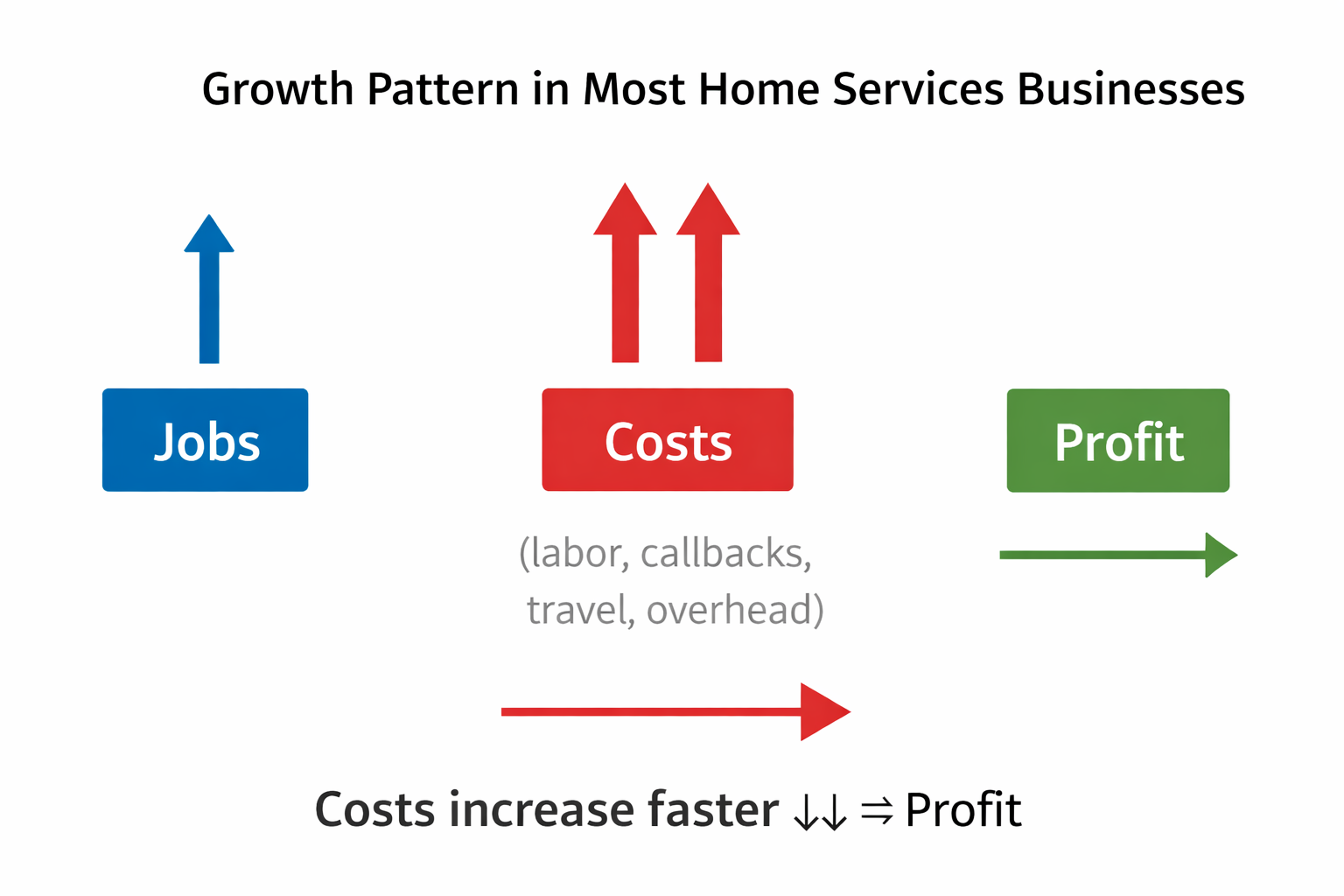
This is the question I hear most often from home services owners. The business is fully booked, the phones are ringing, and yet the owner is still stressed about cash. Understanding why is fundamental to HVAC business growth — and the answer almost always lives in one of three places: job-level margin erosion, unbilled or uncollected revenue, or overhead that has grown faster than the business can support.
Job-level margin erosion is the most common culprit. Drive time is rarely costed correctly. Callback rates on certain technicians or certain job types inflate the true cost of delivery. Materials are purchased inefficiently or priced inconsistently. The top-line looks healthy but the real margin per completed job — once everything is accounted for — is far thinner than it appears.
Unbilled or uncollected revenue is the second issue. Work gets done, invoices go out late, follow-up on unpaid balances is inconsistent, and commercial customers stretch payment terms because no one pushes back. According to
recent Federal Reserve research, small businesses consistently identify cash flow management as one of their top operating challenges — and home services contractors are no exception.
The third factor is overhead creep. As businesses grow, they add office staff, vehicles, software subscriptions, and space — often without a clear model for how those costs are covered by the revenue each additional asset or person generates.
Key Takeaway
Busy doesn't mean profitable. For home services contractors, financial stress usually traces back to job-level margin erosion, revenue left uncollected, or overhead that has outpaced revenue growth.
↑ Back to Questions
Question 09
How do you fix the most common financial problems holding HVAC growth back?
The fixes vary by business, but there are several high-impact levers that apply broadly across HVAC contractors pursuing home services business growth.
First, build a 13-week rolling cash forecast and review it every week. This single habit eliminates cash surprises and creates the discipline to make spending decisions proactively rather than reactively. For seasonal businesses, it also makes it possible to plan off-season months — marketing pushes, equipment investments, training — with full visibility into what the cash position will look like.
Second, get
job-level margin visibility into your field service management software. If you can't see the margin on a $1,200 HVAC tune-up versus a $12,000 system replacement by the technician who completed it, you're making pricing and staffing decisions without the most important data available to you.
Third, review your service call fee and diagnostic pricing. Many contractors underprice service calls because they fear customer pushback, then try to make it up on parts and equipment. This creates pricing tension and erodes trust. A well-structured service call fee — priced to reflect the true cost of dispatch, drive time, and technician expertise — is one of the most straightforward margin improvements available to most home services businesses.
Key Takeaway
The highest-impact fixes for home services financial problems are a weekly cash forecast, job-level margin tracking in your field service software, and a correctly structured service call fee.
Book a complimentary call to work through these with us.
↑ Back to Questions
Question 10
How is AI changing HVAC business growth?
The home services industry is at an early but meaningful inflection point with AI. The most immediate impact is in
dispatch and scheduling optimization — tools that reduce drive time, improve technician utilization, and surface the highest-value jobs for available technicians. For an HVAC company running eight trucks, even a 10% improvement in utilization can translate directly to the bottom line.
On the financial side, AI is beginning to automate the tasks that have historically consumed disproportionate back-office time: invoice matching, payment reconciliation, job costing, and financial reporting. Platforms like ServiceTitan are integrating AI-driven analytics that surface insights — which technicians have the highest close rates, which zip codes generate the best margin, which customers are due for a maintenance visit — that previously required a dedicated analyst to produce.
The strategic implication for home services business growth is significant: the businesses that adopt these tools thoughtfully will be able to run leaner back offices, make faster decisions, and compete more effectively for the same technician labor pool. The ones that don't will find the gap between their cost structure and their competitors' widening over time.
At Oryx Horn, we help contractors identify exactly where AI tools will generate a return in their specific operation — and where the investment is premature given where the business currently sits.
Key Takeaway
AI is creating real, near-term advantages for HVAC business growth — particularly in dispatch optimization and back-office automation. The key is identifying the right tools for your current stage of growth, not adopting technology for its own sake.
↑ Back to Questions